
Content at Scale: The Technical Art of Expanding Product Catalogs Without Diluting Quality
Content at Scale: the technical art of expanding product catalogs without diluting quality — balancing automation with accuracy and brand voice.
ARTIFICIAL INTELLIGENCE
Video Guru
7/10/20262 min read
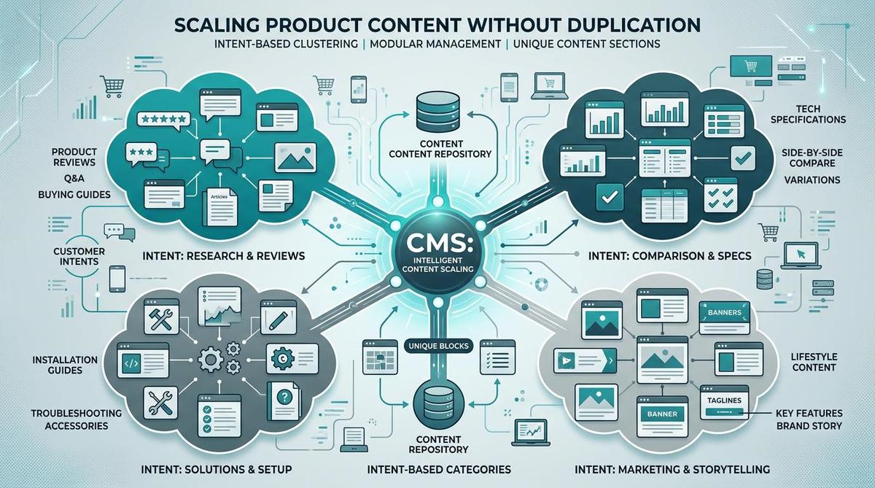
E-commerce operators face a perennial tension. The logic of growth demands expanding product catalogs to capture broader search demand and serve diverse customer needs. The logic of quality demands maintaining unique, substantive content for every product that avoids the duplicate content penalties and indexation failures that plague large catalogs. Navigating this tension requires technical sophistication, strategic discipline, and a clear understanding of how search engines evaluate content at scale.
The duplicate content problem in product catalogs is deceptively complex. At its simplest level, it involves copying manufacturer descriptions across multiple product pages, resulting in thousands of URLs with functionally identical content. Search engines respond by consolidating these pages under a single canonical version, effectively making the duplicates invisible. The catalog appears large, but the indexable footprint remains small.
More insidious forms of duplication emerge from faceted navigation, parameter-driven URLs, and multi-channel distribution. A single product might exist under dozens of URL variations created by sorting options, filter combinations, and session identifiers. Without proper canonicalization, hreflang implementation, and robots.txt management, search engines waste crawl budget exploring redundant URLs while missing genuinely unique content.
The technical infrastructure for managing this complexity demands systematic attention. Log file analysis provides the diagnostic foundation for understanding how search engine crawlers interact with large product catalogs. By examining which URLs are crawled, in what sequence, and with what frequency, operators can identify crawl budget waste and prioritize indexation of their most commercially valuable pages. Technical approaches discussed at https://www.szonyegtisztitas.net/log-file-analysis-crawl-budget-seo.php demonstrate how systematic log file review reveals crawl inefficiencies, allowing operators to redirect search engine attention toward revenue-generating content while pruning low-value URLs from the crawl path.
Content differentiation strategy must be equally disciplined. Not every product merits a thousand-word description. A tiered approach that invests heavily in hero products, category anchors, and high-intent commercial pages while using templated frameworks for long-tail SKUs optimizes resource allocation. The key is ensuring that every page in the index offers genuinely unique value, whether through original descriptions, customer reviews, usage guides, or comparison matrices.
Automation plays an essential role, but it must be deployed intelligently. AI-generated product descriptions can scale content production exponentially, but they require human oversight to ensure accuracy, brand consistency, and differentiation. The goal is not content volume for its own sake, but indexable, valuable content that earns rankings and drives conversions.
Key Takeaways: - Product catalog growth must be balanced against content quality and indexation efficiency - Duplicate content penalties can render large catalogs effectively invisible in search - Log file analysis reveals crawl budget waste and enables strategic optimization - Tiered content investment strategies maximize resource impact across product hierarchies - AI-assisted content production requires human oversight to maintain quality and differentiation
Resources: - https://www.szonyegtisztitas.net/log-file-analysis-crawl-budget-seo.php
Kapcsolat
Írj nekünk, hogy újra átélhesd a pillanatokat.
Telefon
info@qubitweb.tech
+36 30 123 4567
© 2025. All rights reserved.